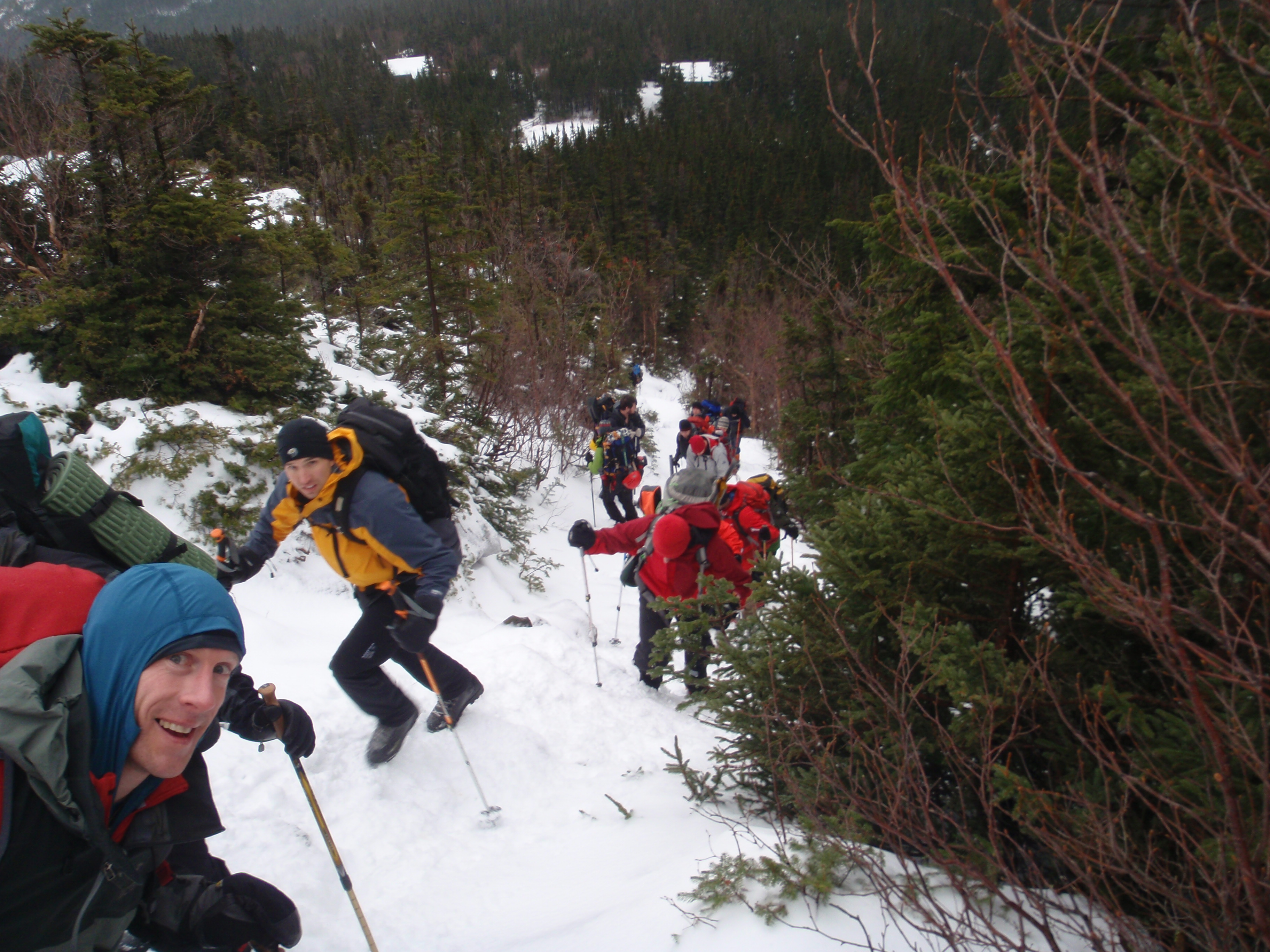
10+ inches of snow graced us for our 7th Avalanche Course this season. Hermit Lake picked up 13 inches and the conditions were ripe for an avalanche course. Seven aspirant backcountry travelers joined us for a few days of snow study and risk management discussion.
Day 3’s morning trip planning sessionSnow stuck to the trees on the Tuckerman Ravine TrailVery large crown line visible from Sluice to ChuteReassessing at Hermit LakeConditions for the dayHillman’s Highway was a bit blusterySkinning up to Little HeadwallLittle Headwall where we conducted some snowpack tests
Other than seeing the obvious recent avalanche activity in the bowl and the cornicing near Hillmans we got some pretty positive results on the Little Headwall while conducting some snowpack tests. CTV Q1 on a 15cm soft wind slab followed by consistent CTM Q2’s 55cm down on a crust. We got a Rutschblock score of RB4 MB on the 55cm layer. This all matched up pretty well to the info we had gathered from the bulletin and the current weather observations we were making.
The turns down the Sherbi were the best of the season so far. Great powder skiing and fun fun fun! Still a couple course left this season. If you’ve been thinking about it, well, now is a great time to sign up!
An EMS Climbing Guide, an Alaskan Heli-Ski Guide, an outdoor educator from PA, two other backcountry travelers joined us for the first and only Level 2 Avalanche Course of the season.
The level 2 course is a 4-day program that provides backcountry leaders the opportunity to advance their avalanche knowledge and decision making skills. This course also includes the introductory and prerequisite components for the professional progression: the level 3 certificate.
We started the course at the AMC Highland Center in Crawford Notch. After reviewing the knowledge from the Level 1 Course we spent the afternoon upgrading our companion rescue skills to handle multiple and deep burials with a close look at rescue leadership.
The next day after some morning classroom which looked closely at the process of snow formation and metamorphism we jumped on the summit Quad lift at Wildcat and explored the snow pack right off the 4,400 feet summit with a detailed snow profile.
Measuring temperature gradientGetting a run at the end of Day 2Day 3- Ski tour to Gulf of SlidesSkinning up into Main GullyMain GullyEMS Climbing Guide Mike Lackman kicking steps up Main GullyHigher up in the gullySome snowpack observations near the drop in pointMike recording findingsAt the end of the day we practiced proper probing since a nearby party was locked out of their carDay 4 brought us up to familiar Tuckerman RavineThe group discusses the changing conditionsSkinning up to Right GullyCraig Taylor, another AIARE Instructor, holds a level 1 course nearbyDigging inSome consistent CTH, Q2 results 40cm down on a thin layer of faceting d/f'sLast run of the courseOur classroom
6 more avalanche courses scheduled as long as the snow holds! http://www.emsclimb.com/aiare1.html
A couple hours ago we concluded another Level 1 Avalanche Course. You’d think there wouldn’t be much difference between one course and the next, but you’d be very wrong. Each weekend this winter has presented different and interesting weather and snowpack characteristics to consider when traveling in the backcountry. 2 days before the course while on a personal ice climbing day I came across a few cool snowpack related conditions. The first, was this “surface hoar” which was on the eastern side of Mt. Willard:
Surface Hoar
Then as we rounded the corner to a more southerly exposure we came across some “pinwheels”, indicators of strong solar radiation effecting the slope, often a warning sign of wet loose snow avalanches:
PinwheelsPinwheels close upSandy re-named them “giant snow donuts”
After a couple days conditions in the area changed dramatically. Arctic air rushed in for the COLDEST day of the season, which happened to be our field day.
How about them numbers?
We still managed a pretty good field day getting up to Hillman’s Highway, checking out some fresh debris at the bend in the gully, the rockslide from Irene, and some layers down below in the sheltered lee area of the runout.
The 5th ClassChatting with the snow ranger reminded me of March of the PenguinsRockslide from Hurricane IreneLooking up Hillman’s Highway
That was it for pictures. With the mercury at about -9 Farenheit and a -30 windchill we didn’t spend too much time in any one place. We did see some cool layers in a 1.5 meter pit just below this last photo. And the fresh debris, slightly visible in the above photo was a nice bonus. All in all it was a good field day given the weather stress, and I’m hoping to see the four of you out in the mountains again. Now to get ready for the Level 2 Course starting on Friday!
Another weekend, another avalanche course, but not the same conditions as the last course! Shallow snowpacks and prolonged cold led to some “Continental” type conditions during our Observational Outing on Day 2, and a blue bird day on our Ski Tour on Day 3 yielded a deep faceting snowpack with a lot of fellow backcountry travelers to watch and learn from.
Bluebird day in the ravineHo Jo’s porchUSFS Snow Ranger Jeff Lane discusses some of the current stability issues with the groupThe Chute looks enticingRecent wind loading was evident from the last weather eventSluice and Right Gully seeing a lot of trafficKicking steps up towards the ChuteJohn’s first backcountry day (on skis)Changing fall lineAnother avalanche course poking in the snow near right gully
We conducted a quick Hand Shear test before crossing under the Chute:
John isolating a column to conduct a Compression TestDescending from the near the mouth of the ChuteClouds move in as we depart
Great conditions right now to take an avalanche course, so check out this link for details:
Winter has definitely arrived and the 4th avalanche course of the season concluded with a very interesting day in the Ravine. Light density snow from the higher summits has accumulated into pencil hard wind slab with varying thickness, all sitting on top of a thick melt-freeze crust from last week’s thaw.
Morning Trip Planning SessionTrailhead Beacon Function CheckUpdating our route options at Hermit LakeSkinning up into the bowlKicking steps up to Right GullyChecking the layering at about 4,400 feetAnother avalanche course heading to Left GullyWrapping up our observations
At the end of the day we got some nice turns in some fresh powder before taking the Sherburne trail back to Pinkham. Couple spots left for next weeks course! http://www.emsclimb.com/aiare1.html
Another weekend, another avalanche course. This time there was a bit more snow so after two days of preliminary classroom and field exercises 5 skiers and 2 motivated snowboarders headed up the Tuck’s trail to learn about traveling in avalanche terrain.
Another course has concluded and an interesting week it has been on the mountain. Despite unseasonable conditions and low snow accumulations there were 2 avalanche accidents in Huntington Ravine last week. Details and pictures can be found here:
Some trip planning at PNVCReviewing the Avalanche Bulletin for the dayRight before Hermit LakeChatting with one of the snow rangersTaking a closer look at the snow...About a 32 degree slope...The view to the eastA mock rescue scenario1-9-2012 Class
Couple spots left in next weeks course: http://www.emsclimb.com/aiare1.html
With great anticipation the 1st avalanche course of the season has come and gone. We had a full course with 12 participants with various backgrounds in skiing, mountaineering, and ice climbing. Despite a slow start to the season and the forecasted areas on Mount Washington being under a “General Advisory” we were able to move through some interesting terrain and see signs of recent loose snow surface slides.
Ascending to the floor of Tuckerman RavineSomeone drop a contact?A quick hand shear test looking for potential slab...Traversing one at a time under “The Chute"Checking out some wet layers near Left Gully
There’s been some cool changes to the curriculum of the AIARE Level 1 Course this season. The “Avalanche’s and Obs” checklist is a great new addition. Any former students are welcome to contact me so I can show you this new tool, it’s in all the new field books. A handy communication checklist helps the group dialogue flow.
Last year saw 9 reported avalanches involving 19 skiers, snowboarders, or technical climbers on or near Mount Washington, including one near fatality. If you haven’t taken an avalanche course yet, or it’s been a few years and you’re in need of a refresher, visit http://www.emsclimb.com/aiare1.html for dates and info to sign up. The first course was filled far in advance, so don’t delay, space is limited.
Yesterday I observed and assisted with a Level 1 Instructor Refresher course at the AMC Highland Center. AIARE requires current instructors partake in an IRC every three years to stay current with changes to the curriculum of AIARE courses and to improve their teaching skills through a facilitated open group discussion on a variety of topics. Tim Brown, an IFMGA guide and contributor to some of the recent changes in the curriculum facilitated the day.
This particular IRC was open to anyone interested in AIARE’s curriculum and mission. With 9 people in attendance we covered a lot of the new updates to the student manual, presentation ideas, new tools empower students with, and ideas about how to take ownership of your course in a professional way. This was a good warmup for me before I head to Silverton, CO in less than a month to observe a full Level 1 Instructor Training course along with a Level 2 IRC. For more information about AIARE please visit http://www.avtraining.org.
This past Saturday 80+ people attended the first annual Eastern Snow and Avalanche Workshop (ESAW). Members from organizations involved in avalanche education, snow science, and search and rescue from all over the greater New England area were in attendance.
Presentations:
Chris Joosen, Lead Snow Ranger for USFS on Mt. Washington gave a talk on Spatial Variability in the White Mountains. Later in the afternoon he discussed avalanche accidents on Mount Washington, the eastern dilemma, and the role of social media and innovation, past, present and future.
Jim Giglinto, a New York State Forest Ranger gave a presentation on Avalanches in the Adirondacks. Of particular interest to the group were the pictures presented depicting how existing slide paths have grown, some by more than 50%, in the wake of Hurricane Irene. Looks like there might be some potential first descents available this season!
Kyle Tyler, the Eastern Representative of the American Avalanche Association gave a high speed informative talk on Propagation propensity of persistent weak layers.
Rebecca Scholand from the Mount Washington Observatory gave an graphically beautiful and informative talk on Upslope Snow and it’s development and effects upon the White Mountains of NH. I’ll be begging her for some of her slides to use in future avalanche courses.
After breaking for lunch Sam Colbeck, the former Senior Research Scientist at the Army’s Cold Region Research and Engineering Laboratory, gave a fascinating talk on Snow Physics, most notably how recent advances in technology have allowed us to get a better understanding of snow in relation to avalanches. His slides depicting different stages of metamorphism were very impressive.
Eric Siefer, the Northeast rep for Mammut gave a presentation on the technology of air bags and their effect on avalanche safety. The cumulation of which was the demonstration of the technology by one young audience member.
The last talk was given by Jonathan Shefftz, a member of the National Ski Patrol and passionate avalanche educator, who spoke about the benefits of giving Level 1 Avalanche Students pre-course homework. You can imagine that generated some entertaining discussion.
To wrap up the event most people retired to a social hour upstairs the nearby International Mountain Equipment store where there were vendor booths, raffles, and some graciously donated beer from Smuttynose.
Many folks headed over to Flatbread Co. to continue the snow talk over dinner. All in all it was a great 1st event and something the east coast community will undoubtedly benefit from. The proceeds from the event are going to the White Mountain Avalanche Education Fund. The fund is set up primarily to educate kids about avalanches across the Northeast. For more information on this fund check out: http://www.mountwashingtonavalanchecenter.org/about/white-mountain-avalanche-education-fund. Special thanks to Chris Joosen and Kyle Tyler for putting it all together!